
MIPS Submission Deadlines: Window, Dates & Extensions


MIPS Submission Deadlines are the CMS published reporting cycle dates governing the Merit-Based Incentive Payment System (MIPS) under the Quality Payment Program (QPP). For the 2026 performance year (PY2026), the submission window opens January 2, 2027, and closes March 31, 2027, at 8 p.m. Eastern Time.
CMS releases the MIPS feedback report in summer 2027, and the payment adjustment applies to Medicare Part B reimbursement during calendar year 2028. The sections below cover the submission window, the full PY2026 calendar of key dates, and the extension paths available if a deadline is missed.

What are MIPS submission deadlines?
MIPS submission deadlines are the calendar dates CMS publishes each performance year. They govern when clinicians and groups must collect data, submit MIPS performance to the Quality Payment Program (QPP) submission API, file hardship exceptions, and request post feedback Targeted Reviews.
Each MIPS reporting cycle spans three years. The performance year is for data collection. The year after the performance period is for submission and feedback. The second year after the performance period is for payment adjustment. PY2026 reporting, therefore, reaches calendar year 2028 Medicare Part B reimbursement.
CMS publishes the MIPS calendar annually in the Physician Fee Schedule Final Rule. The PY2026 calendar was confirmed in the CY 2026 Final Rule published November 5, 2025. The two questions below explain whether CMS ever extends these deadlines and what happens if a clinician misses one.
Does CMS extend MIPS submission deadlines?
Rarely.CMS does not routinely extend the published MIPS submission window deadline. Extensions are granted only when CMS declared circumstances apply. These typically include a Public Health Emergency (PHE), a CMS submission infrastructure outage, or a system-wide Extreme and Uncontrollable Circumstances (EUC)determination. When CMS does extend, the announcement is posted on the CMS Quality Payment Program (QPP) Resource Library. Individual practices cannot request a window extension. Practices facing individual hardships use the CMS Hardship Exception path instead of seeking a window extension. That path is covered later in this article.
What happens if a clinician misses the MIPS submission deadline?
A clinician or group that misses the MIPS submission deadline without an approved Hardship Exception receives the full 9 percent negative MIPS payment adjustment for the corresponding payment year. For PY2026 reporting, with a submission window of January 2 through March 31, 2027, the 9 percent adjustment applies to all Medicare Part B claims billed during calendar year 2028.
A practice can still file a Hardship Exception in narrow circumstances after the deadline. That path is one of the three extension paths covered later in this article. Retroactive approval is not guaranteed.
What is the MIPS submission window?
The MIPS submission window is the three-month period each year during which clinicians and groups transmit performance data to the CMS Quality Payment Program (QPP) submission API. For the 2026 performance year (PY2026), the submission window opens January 2, 2027, and closes March 31, 2027, at 8 p.m. Eastern Time.
This is the same three-month window CMS has used since the program began. Data submitted before the window opens or after the window closes is not counted toward PY2026 scoring. The window applies regardless of which of the five MIPS reporting methods the practice uses. These methods are Qualified Registry, EHR through Certified Electronic Health Record Technology (CEHRT), Qualified Clinical Data Registry (QCDR), Medicare Part B claims, and the legacy CMS Web Interface.
Each method has its own data preparation cadence before the window opens. The three sections below cover each window sub-item in detail: Window Open, Window Close, and Resubmission Mid Window.
Window Open (January 2, 2027)
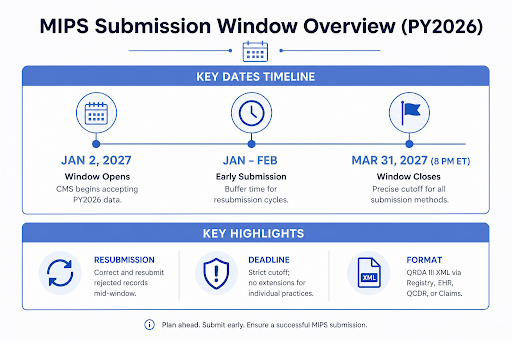
The MIPS submission window for PY2026 opens January 2, 2027. This is the date the CMS Quality Payment Program (QPP) submission API begins accepting performance year 2026 data. CMS does not accept submissions before the window opens. Practices and Qualified Registries finalize PY2026 data validation during November and December 2026 to prepare.
They do not transmit data until January 2, 2027. Submitting in early January, rather than late March, leaves buffer time for resubmission before the window closes. That buffer matters most when a record is partially rejected. The next section explains how that resubmission process works.
Window Close (March 31, 2027, at 8 p.m. ET)
The MIPS submission window for PY2026 closes March 31, 2027, at 8 p.m. Eastern Time. This is the precise cutoff after which the CMS QPP submission API stops accepting PY2026 data. Data submitted after 8 p.m. Eastern Time on March 31, 2027, is not counted toward PY2026 scoring.
This rule applies regardless of submission method or vendor. CMS does not extend this cutoff for individual practices. The cutoff applies in Eastern Time. A practice on Pacific Time has until 5 p.m. Pacific Time on March 31, 2027, to transmit data. Practices in Hawaii or Alaska time zones should plan against the Eastern Time cutoff.
Resubmission Mid-Window
Resubmission Mid Window allows a clinician or Qualified Registry to correct rejected measure records. The clinician or registry can resubmit the affected measures any time before the window closes at 8 p.m. Eastern Time on March 31, 2027. CMS validates each measure record independently at submission.
Records that fail validation are returned with measure-level error codes. The Registry or EHR vendor corrects the errors and resubmits the affected measures. The submission API accepts repeated resubmissions throughout the window. Most Qualified Registries advise transmitting in early January 2027 to leave buffer time for one or two resubmission cycles before March 31.
Missing the cut-off with uncorrected rejections triggers the full missed deadline consequence. After the window closes on March 31, 2027, at 8 p.m. Eastern Time, records that remain rejected are excluded from PY2026 scoring. Targeted Review, covered later in this article, is the only recourse after that point.
What are the key MIPS dates for the 2026 performance year?
The 2026 MIPS performance year (PY2026) follows a sequenced calendar of seven key dates. These run from the performance year start through the payment adjustment year. All seven dates were confirmed in the CMS Physician Fee Schedule CY 2026 Final Rule published November 5, 2025. The seven key dates fall into three phases. The pre-submission phase includes the Performance Year, the MVP Registration Window, and the Hardship Application Deadline.
The submission phase is the Submission Window. The post-submission phase includes Feedback Release, the Targeted Review Window, and the Payment Adjustment Year. Each phase runs at a different time and matters on its own for the reporting cycle. The full cycle spans nearly three years, from January 1, 2026, through calendar year 2028. The seven sections below walk through each date in order.
Performance Year Start (January 1, 2026)
The MIPS Performance Year for the 2026 reporting cycle starts January 1, 2026. This is the date practices begin capturing clinical encounters, measuring performance data, and category-specific activity for MIPS submission. Quality measure tracking, Improvement Activities documentation, and Promoting Interoperability evidence collection begin January 1, 2026.
This activity continues through December 31, 2026. CMS calculates Cost performance from Medicare Part B claims billed during the same January 1 through December 31, 2026 window. Clinicians do not submit Cost data directly.
MVP Registration Window (April 1 – November 30, 2026)
Clinicians and groups electing to report a MIPS Value Pathway (MVP) for PY2026 must register during the MVP Registration Window. This window runs April 1 through November 30, 2026. Solo clinicians, groups, virtual groups, and APM Entities all use the same registration window. Registration is completed through the CMS QPP portal using HARP credentials, the CMS authentication system for the Quality Payment Program.
Clinicians who do not register an MVP by November 30, 2026, default to Traditional MIPS reporting for PY2026. Multispecialty groups reporting an MVP must register as subgroups, a requirement starting in 2026. Each subgroup has its own MVP election.
Hardship Application Deadline (December 31, 2026)
The MIPS Hardship Application Deadline for PY2026 is December 31, 2026. By this date, clinicians or groups must file a CMS Hardship Exception application to receive reweighting of one or more performance categories for PY2026. Common hardship triggers include decertification of the practice’s certified electronic health record technology, lack of sufficient internet access for Promoting Interoperability, or a CMS declared Public Health Emergency.
The full list is published in the CMS QPP Resource Library. An approved Hardship Exception reweights the affected category to zero. The remaining categories absorb that weight proportionally. Hardship applications submitted after December 31, 2026, are not accepted, except in CMS declared Extreme and Uncontrollable Circumstances determinations.
Submission Window (January 2 – March 31, 2027)
The PY2026 MIPS Submission Window opens January 2, 2027, and closes March 31, 2027, at 8 p.m. Eastern Time. During this period, clinicians and Qualified Registries transmit performance data to the CMS QPP submission API. Data submitted before January 2, 2027, or after 8 p.m. Eastern Time cut off on March 31, 2027, is not counted toward PY2026 scoring. For the full breakdown of window open, window close, and mid window resubmission, see the MIPS submission window section earlier in this article.
Feedback Release (Summer 2027)
CMS releases the PY2026 MIPS feedback report in summer 2027, typically late June through early August. The report is released through the Quality Payment Program (QPP) portal. Clinicians get their MIPS feedback by logging into the QPP portal with HARP credentials.
They navigate to the MIPS feedback section and download the annual feedback report. The feedback report contains the MIPS Final Score, category level scores, measure level performance, the applied payment adjustment percentage, and a per-claim dollar impact projection. Feedback release opens the 60-day Targeted Review window, covered in the next section.
Targeted Review Window (60 Days from Feedback Release)
The Targeted Review Window opens on the day CMS releases the annual MIPS feedback report. It runs for 60 days, giving clinicians and groups a fixed period to file a Targeted Review challenge against the MIPS Final Score. A Targeted Review challenges the calculated MIPS Final Score, attribution accuracy, category level performance scores, or special status determinations. It does not reopen submission for new data.
Clinicians submit Targeted Review requests through the QPP portal using HARP credentials, along with supporting documentation. CMS reviews each request and issues a determination within its published response timeline. A Targeted Review filed after the 60-day window closes is not considered. The Final Score becomes final at that point and carries forward to the Payment Adjustment Year.
Payment Adjustment Year (Calendar Year 2028)
The PY2026 MIPS payment adjustment applies during the Payment Adjustment Year, calendar year 2028. During this year, the adjustment percentage is applied to every Medicare Part B claim billed by the clinician or group. A two-year gap separates the performance year from the payment adjustment year.
CMS needs that time to release feedback in summer 2027, accept Targeted Reviews for 60 days, finalize the Final Score, and apply the adjustment through the Medicare claims processing system. The adjustment appears on each Medicare Remittance Advice sent to the clinician throughout calendar year 2028.
The adjustment compounds with that year’s Medicare Physician Fee Schedule updates. After calendar year 2028 ends, the PY2026 cycle is complete. By then, the PY2027 cycle is already in its submission and feedback phases.
How can a practice handle a missed MIPS submission deadline?
A clinician or group facing a missed MIPS submission deadline has three CMS recognized extension or recovery paths, plus one post-deadline data correction question. None of these paths is guaranteed. Each is available only under specific CMS defined conditions.
The three extension paths are the CMS Hardship Exception, filed in most cases by December 31, 2026; Reweighting via Special Status, applied automatically by CMS for qualifying practice types; and Targeted Review Filing, the post feedback recourse covered as a calendar item earlier in this article. The four sections below cover each path in turn.
CMS Hardship Exception
The CMS Hardship Exception is the primary deadline handling path. It is a formal application that, when approved by CMS, reweights the affected MIPS performance categories to zero for the affected reporting cycle. Hardship Exception applications are filed through the QPP portal by December 31, 2026, for PY2026 categories.
The form documents the specific hardship trigger and the affected categories, most commonly Promoting Interoperability. Common triggers include decertification of certified electronic health record technology, lack of sufficient internet connectivity in rural or Health Professional Shortage Area practices, a CMS declared Public Health Emergency, or Extreme and Uncontrollable Circumstances.
Each trigger has its own documentation requirement. When approved, the reweighted category is treated as if not submitted. The remaining categories absorb the weight proportionally, under the CMS re-normalization rule covered on the scoring and payment hand-off page.
Reweighting via Special Status
Reweighting via Special Status is the automatic deadline handling path. CMS reweights certain performance categories to zero based on the practice’s eligibility for a CMS defined special status. No application is required.
Common special statuses that trigger automatic reweighting include small practices, defined as a Taxpayer Identification Number with 15 or fewer eligible clinicians, as well as hospital-based and Ambulatory Surgical Center-based clinicians. They also include non-patient-facing clinicians and those practicing in rural areas or designated Health Professional Shortage Areas.
Most special status reweightings apply automatically based on CMS determination period analysis. CMS notifies affected clinicians through the QPP portal feedback. Special status reweighting most commonly affects Promoting Interoperability. Small practice, hospital-based, Ambulatory Surgical Center-based, and non-patient-facing statuses all reweight that category to zero. The reweighting occasionally affects the cost for low-volume practices.
Targeted Review Filing
Targeted Review Filing is the post feedback recourse path. A clinician or group files a formal challenge with CMS within 60 days of feedback release if the MIPS Final Score, attribution, or scoring methodology appears incorrect. A Targeted Review can challenge a Final Score calculation, category-level scoring, measure attribution, special status determination, or eligibility classification. It cannot reopen the submission for new data.
The request is filed through the QPP portal with HARP credentials. CMS requires supporting documentation, such as the contested calculation, evidence of correct data, or attribution records. The 60-day window starts the day CMS releases the annual feedback report.
When CMS upholds the Targeted Review, the Final Score is recalculated, and the payment adjustment is updated. Recalculated Final Scores affect the Payment Adjustment Year, calendar year 2028, for PY2026. Mid-year adjustments are possible when CMS approves the review during calendar year 2028.
Can a practice submit corrected data after the deadline closes?
No. Corrected MIPS data cannot be submitted to CMS after the submission window closes at 8 p.m. Eastern Time on March 31, 2027, for PY2026. The CMS Quality Payment Program (QPP) submission API stops accepting data at that cutoff.
There is no reopen mechanism for individual practices. Practices that identify data errors after the close use Targeted Review, covered above, as the only recourse. A Targeted Review can challenge the Final Score calculation. It cannot add data records to the original submission.
How do MIPS deadlines tie into scoring and payment adjustment?
MIPS deadlines are tightly coupled to the scoring and payment adjustment cycle. Each deadline is a gate. It determines whether and how a clinician’s performance data turns into a MIPS Final Score and ultimately a Medicare Part B payment adjustment.
The deadline to score to payment flow runs in order: Performance Year for data capture, Submission Window for data transmission, Feedback Release for Final Score calculation, Targeted Review for the 60-day Final Score challenge window, and Payment Adjustment Year when the Final Score is applied to Medicare Part B claims.
When is the deadline to opt into MIPS reporting?
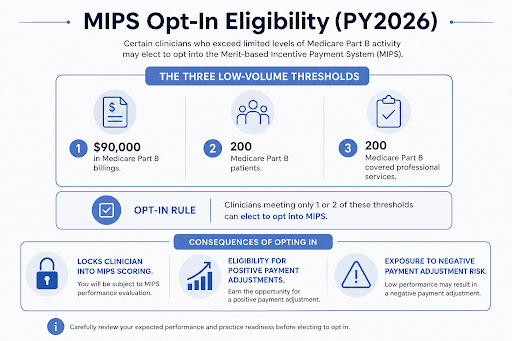
Clinicians who meet partial MIPS eligibility, exceeding one or two of the low-volume threshold criteria but not all three, can elect to opt into MIPS reporting. CMS sets the opt-in deadline annually as part of the MIPS Determination Period. CMS determines MIPS eligibility against three low-volume thresholds.
These are $90,000 in Medicare Part B billings, 200 Medicare Part B patients, and 200 Medicare Part B covered professional services. Clinicians who meet only one or two of these thresholds are eligible to opt in. The opt-in election applies to the full PY2026 reporting cycle. It locks the clinician into MIPS scoring, including positive payment adjustment upside and negative payment adjustment risk.
How does Macralytics manage the MIPS deadline timeline?
Macralytics manages the MIPS deadline timeline through a four step workflow that maps to the calendar items above.
- Calendar planning: at the start of each Performance Year, the Macralytics team builds a customized performance year cycle calendar for the partner practice. This calendar covers all seven calendar dates plus practice-specific milestones, such as specialty registration windows and MVP elections.
- Pre-submission monitoring: the team tracks and measures performance throughout the Performance Year. It flags data completeness gaps before December, files Hardship Exception applications by December 31 where applicable, and validates submission readiness in November and December.
- Submission window execution: data is transmitted to the CMS QPP submission API in early January 2027 for PY2026. Resubmission cycles run through the window to clear partial rejections before the March 31 cutoff.
- Post feedback review: after CMS releases the annual MIPS feedback report in summer 2027, the team reviews attribution accuracy. It files Targeted Reviews on the practice’s behalf within the 60-day window if discrepancies appear.
Can MIPS submission deadlines change mid-year?
Rarely.MIPS submission deadlines are set in the annual CMS Physician Fee Schedule Final Rule. The PY2026 calendar was confirmed in the CY 2026 Final Rule on November 5, 2025. CMS does not typically adjust deadlines mid-year. Three exception paths can alter deadlines mid-year.
The first is a CMS declared Public Health Emergency, where CMS announces a deadline extension for affected clinicians. The second is a CMS system outage affecting the submission API, where CMS announces a window extension proportional to the outage duration. The third is a CMS rule-making correction issued through a mid-year Federal Register notice, which is rare but possible.
Practices should plan against the published Final Rule deadlines without assuming extensions. CMS publishes any deadline changes immediately on the QPP Resource Library and through MLN Connects notifications. CMS does not grant individual practice deadline extensions. The CMS Hardship Exception, covered earlier in this article, is the individual practice path for category reweighting, not for window extension.
Closing
MIPS Submission Deadlines are the CMS published reporting cycle dates that govern Merit-Based Incentive Payment System (MIPS) participation under the Quality Payment Program (QPP). For PY2026, the calendar runs from January 1, 2026, the Performance Year start, through March 31, 2027, at 8 p.m. Eastern Time, the submission window closes. Feedback is released in summer 2027, and payment adjustments apply during calendar year 2028. The three CMS recognized extension paths, the CMS Hardship Exception, Reweighting via Special Status, and Targeted Review Filing, are the only relief paths for clinicians and groups facing missed deadlines. For a broader MIPS context, see our Merit-Based Incentive Payment System (MIPS) guide.
Schedule your free MIPS consultation.
Drop your work email and a certified MIPS consultant will reach out to schedule a personalized consultation, no obligation.