
MIPS Reporting Methods: Registry, EHR, QCDR, Claims


MIPS reporting methods are the five CMS-approved paths for submitting performance data under the Merit-Based Incentive Payment System (MIPS). The four mainstream methods are Qualified Registry, CEHRT-equipped EHR, Qualified Clinical Data Registry (QCDR), and Medicare Part B claims.
The fifth is the sunsetting CMS Web Interface. MIPS Value Pathways (MVPs) run alongside as an alternative framework that bundles measures by specialty. CMS publishes 27 MVPs for the 2026 performance year, including 6 new specialty pathways.
What are MIPS reporting methods?
MIPS reporting methods are the five CMS-approved channels clinicians and groups use to submit performance data to CMS. The submissions feed the Merit-Based Incentive Payment System (MIPS), the program run by the Centers for Medicare and Medicaid Services (CMS). MIPS is one of two tracks under the Quality Payment Program (QPP), created by MACRA in 2015.
The choice of method depends on practice size, specialty, and technology maturity. Each method can submit a different mix of MIPS categories, and the four mainstream methods remain broadly available for 2026.
The table below compares the five methods across submission unit, best fit, supported categories, and 2026 status.
| Method | Submission unit | Best fit | MIPS categories supported | 2026 status |
|---|---|---|---|---|
| Qualified Registry | TIN or NPI | Most groups | All four (Quality, Cost, PI, IA) | Active |
| EHR (CEHRT) | TIN or NPI | CEHRT-mature practices | Quality, PI, IA | Active |
| QCDR | TIN or NPI | Specialty practices | Quality (specialty plus non-MIPS), PI, IA | Active |
| Medicare Part B Claims | NPI only | Small practices (TIN 15 or fewer) | Quality (claims-based subset) | Active (limited) |
| CMS Web Interface | Group | Legacy ACOs | Quality, PI (historical) | Sunsetting |
The sections below explain how reporting methods feed the MIPS final score, how many methods CMS approves for 2026, and whether clinicians can mix methods in one performance year.
How Do MIPS Reporting Methods Feed the MIPS Final Score?
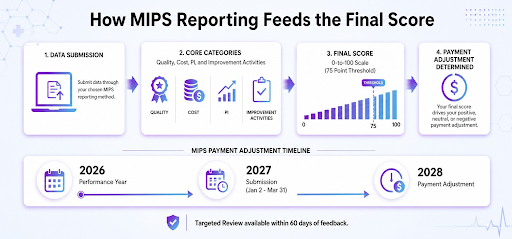
Data submitted through any MIPS reporting method feeds the four MIPS performance categories (Quality, Cost, Promoting Interoperability, and Improvement Activities). These categories combine into a single MIPS Final Score on a 0-to-100 scale. A performance threshold of 75 points separates positive from negative payment adjustments for the 2026 performance year.
Clinicians submit performance-year data through their chosen method during the CMS submission window, January 2 through March 31 of the following year. CMS then calculates the MIPS Final Score and releases the annual MIPS feedback report.
CMS applies the payment adjustment two years after the performance year. Performance year 2026 affects 2028 Medicare Part B payments. Clinicians who disagree with the final score can request a Targeted Review within 60 days of feedback release.

How Many MIPS Reporting Methods Does CMS Approve For 2026?
CMS approves five standard MIPS reporting methods for the 2026 performance year: Qualified Registry, EHR via CEHRT, Qualified Clinical Data Registry (QCDR), Medicare Part B claims, and the CMS Web Interface (sunsetting). Four methods remain active and broadly available. The CMS Web Interface is sunsetting and available only to legacy users.
MIPS Value Pathways (MVPs) are not a sixth reporting method. MVPs are a parallel framework for organizing measures by specialty. Clinicians reporting an MVP still submit through one of the five reporting methods.
For 2026, CMS finalized 27 MVPs, including 6 new specialty pathways:
- Diagnostic Radiology
- Interventional Radiology
- Neuropsychology
- Pathology
- Podiatry
- Vascular Surgery
Can Clinicians Mix MIPS Reporting Methods in One Performance Year?
Yes, across MIPS performance categories, but not within a single measure. A clinician can submit Quality measures via a Qualified Registry and PI measures via direct EHR submission. IA attestations can flow through the Registry at the same time. A single measure, for example, Quality measure #001, must be submitted entirely through one method. CMS does not aggregate partial submissions for the same measure from different reporting channels.
What is the MIPS Registry Reporting?
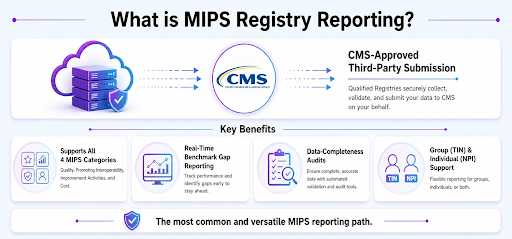
MIPS registry reporting submits performance data to CMS through a Qualified Registry. A Qualified Registry is a CMS-approved third-party vendor that collects measure data, validates it, and transmits the final submission during the submission window.
Registry is the most common MIPS reporting path because it supports all four performance categories. It accommodates both TIN-level (group) and NPI-level (individual) submissions, and it works across specialties.
Beyond data transmission, a qualified registry typically provides:
- Measure selection guidance based on the practice specialty
- Real-time benchmark gap reporting during the performance year
- Data-completeness audits before submission
- Audit-prep documentation for CMS validation
The subsections below cover what a qualified registry is, how data submission works, which MIPS categories it supports, and whether Registry reporting suits small practices. For workflow specifics, see the MIPS Registry reporting workflow details.
What is a CMS-approved Qualified Registry?
A Qualified Registry is a third-party vendor approved by CMS each performance year. The vendor collects, validates, and submits MIPS data on behalf of eligible clinicians and groups.
CMS publishes an updated list of approved Qualified Registries before each performance year. Vendors must reapply annually to maintain certification, so the approved list changes year to year.
Qualified Registries and Qualified Clinical Data Registries (QCDRs) overlap in submission capability but differ in measure scope. The QCDR section below covers the distinction.
How Does Data Submission via Registry Work?
Data submission via a qualified registry follows a three-step workflow: collection, validation, and transmission.
- Collection: Clinicians or the practice export measure data from the EHR, or enter it via a Registry portal during the performance year. Many Registries support API-based EHR integration.
- Validation: The Registry checks data completeness (75 percent for Quality) and measure-specific case minimums (a 20-case minimum for Quality scoring). The Registry flags missing or incomplete records before submission.
- Transmission: The Registry transmits the final submission to CMS during the official submission window, January 2 through March 31 of the year following the performance period.
Groups submit at the TIN (Tax Identification Number) level. All clinicians billing under one TIN are aggregated into a single submission. Individuals submit at the NPI (National Provider Identifier) level.
Which MIPS Categories can be Reported via Registry?
Qualified Registries support submission for all four MIPS performance categories, though the mechanism differs by category.
- Quality: Submitted directly through the Registry. Clinicians choose individual measures or a complete specialty measure set.
- Cost: CMS calculates the cost from Medicare Part B claims. No Registry submission is required, though Registry feedback often includes Cost score projections.
- Promoting Interoperability (PI): Submitted via Registry-integrated EHR data export, which requires 2015 Edition Cures Update CEHRT.
- Improvement Activities (IA): Attested through the Registry portal. The Registry passes attestations to CMS.
Many Registries also offer real-time benchmark gap reporting for Quality measures during the performance year, which lets practices adjust mid-year.
Does Registry Reporting Suit Small Practices?
Yes, Qualified Registries serve small practices well, though small practices have an additional Medicare Part B claims-based option not available to larger groups. Registries offer broader measure availability, real-time benchmark gap reporting, and centralized submission across all four MIPS categories. The trade-off is the Registry subscription cost, which claims-based reporting avoids.
What is MIPS EHR (CEHRT) reporting?
MIPS EHR reporting submits performance data directly from a Certified Electronic Health Record Technology (CEHRT) system to CMS. Direct submission bypasses third-party Registries when the EHR has the certification and API integration to do so.
EHR direct submission requires the 2015 Edition Cures Update CEHRT, certified by the Office of the National Coordinator for Health Information Technology (ONC).
The three subsections below cover:
- The CEHRT requirement that applies to EHR reporting
- Which MIPS categories fit the EHR submission best
- Whether a practice can submit without leaving the EHR
EHR direct submission suits practices with mature CEHRT integration, in-house IT capability, and predictable workflows. Practices without these often submit through a Registry that imports EHR data instead. For the requirement details, see the MIPS EHR direct submission requirements.
What CEHRT Requirement Applies to EHR Reporting?
EHR-based MIPS reporting in 2026 requires 2015 Edition Cures Update CEHRT, the current standard published by the Office of the National Coordinator (ONC).
The Cures Update extends the original 2015 Edition with three additions:
- Information-blocking compliance
- API-based patient data access
- Updated USCDI (United States Core Data for Interoperability) data classes
EHR vendors publish ONC certification IDs, such as the CMS EHR Certification ID, that clinicians use to attest to CEHRT use in MIPS submissions.
Which MIPS Categories Work Best via EHR Direct Submission?
EHR direct submission best supports Quality, Promoting Interoperability (PI), and Improvement Activities (IA), the three categories that involve clinician-submitted data.
- Promoting Interoperability (PI): The natural fit. PI already requires the 2015 Edition Cures Update CEHRT, regardless of submission method, so submitting PI directly from CEHRT keeps one workflow.
- Quality (eCQM): Electronic Clinical Quality Measures (eCQMs) are extracted directly from CEHRT data using ONC-published eCQM specifications.
- Improvement Activities (IA): Attested through the CEHRT vendor MIPS portal, where available, otherwise via a Registry.
Cost is calculated by CMS from Medicare Part B claims. No EHR submission is required for the Cost category.
Can a Practice Submit MIPS Without Leaving the EHR?
Yes, when the CEHRT vendor offers an API-based MIPS submission. Most major EHR platforms certified to the 2015 Edition Cures Update include a built-in MIPS submission module. That module exports eCQM data, PI measure attestations, and IA attestations directly to CMS during the submission window. Practices using older or smaller EHRs without this capability typically submit through a Qualified Registry that imports EHR data instead.
What is MIPS QCDR Reporting?
MIPS QCDR reporting submits performance data through a Qualified Clinical Data Registry (QCDR). A QCDR is a specialty-aligned reporting vendor approved by CMS to submit standard MIPS measures plus non-MIPS measures specific to a clinical specialty.
QCDRs typically focus on a clinical domain such as cardiology, gastroenterology, or ophthalmology. They offer measure sets that go beyond the standard MIPS Quality inventory.
The four subsections below cover:
- What a Qualified Clinical Data Registry is
- How a QCDR differs from a Qualified Registry
- Which specialties benefit most from QCDR reporting
- Whether QCDR measures can replace standard MIPS measures
QCDR-specific measures can substitute for standard MIPS Quality measures when they more accurately reflect specialty clinical work. For specialty measure detail, see MIPS QCDR reporting and specialty measures.
What is a Qualified Clinical Data Registry?
A Qualified Clinical Data Registry (QCDR) is a CMS-approved reporting vendor certified annually. A QCDR submits MIPS performance data and non-MIPS measures specific to a clinical specialty.
CMS publishes an updated QCDR list before each performance year. The QCDR list is typically smaller than the Qualified Registry list because QCDRs serve narrower specialty audiences.
Many QCDRs are operated by professional medical societies, including:
- American College of Cardiology PINNACLE Registry
- American Academy of Ophthalmology IRIS Registry
How Does QCDR Differ From a Qualified Registry?
Qualified Registries and Qualified Clinical Data Registries (QCDRs) both submit MIPS data to CMS. QCDRs hold an additional authority that Registries lack: submitting non-MIPS measures specific to a clinical specialty.
The table below contrasts the two registry types across measure scope, specialty focus, cost, and measure relevance.
| Attribute | Qualified Registry | QCDR |
|---|---|---|
| Measure scope | Standard MIPS measures only | Standard MIPS measures plus non-MIPS specialty measures |
| Specialty focus | Broad cross-specialty | Narrow specialty focus |
| Typical cost | Lower subscription cost | Higher cost; society membership may be required |
| Measure relevance | General MIPS measures | Specialty measures often align with the clinician’s work |
A Registry fits cross-specialty groups, while a QCDR fits practices whose specialty measures score better than the standard inventory. For a side-by-side decision aid, see the QCDR vs Registry comparison.
Which Specialties Benefit Most From QCDR Reporting?
QCDR reporting benefits clinical specialties with two characteristics: limited applicable standard MIPS Quality measures, and an active specialty-society QCDR offering non-MIPS measures that better reflect specialty work.
- Cardiology: American College of Cardiology PINNACLE Registry
- Ophthalmology: American Academy of Ophthalmology IRIS Registry
- Gastroenterology: American Gastroenterological Association GIQuIC Registry
- Orthopedic Surgery: American Joint Replacement Registry
- Anesthesiology: National Anesthesia Clinical Outcomes Registry (NACOR)
- Otolaryngology: American Academy of Otolaryngology Reg-ent Registry
Specialties without a dedicated QCDR typically use a Qualified Registry that covers cross-specialty MIPS measures.
Can QCDR-Specific Measures Replace Standard MIPS Measures?
Yes. QCDR-specific non-MIPS measures count toward the MIPS Quality performance category, alongside or in place of standard MIPS measures. CMS approves QCDR non-MIPS measures annually. Clinicians can mix-and-match standard MIPS measures with QCDR non-MIPS measures to fill the 6-measure Quality selection rule. The total still must include at least one outcome or high-priority measure, the same rule that applies to standard MIPS submission.
What is MIPS Claims-based Reporting?
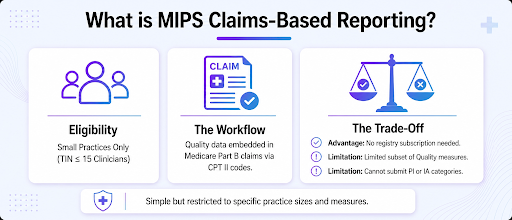
MIPS Claims-based reporting embeds Quality measure data within regular Medicare Part B claims. The practice uses specific CPT II quality codes and modifiers to flag measure performance directly on the claim form.
Claims-based reporting is restricted to small practices, TINs with 15 or fewer eligible clinicians. Larger groups must use Registry, EHR, or QCDR reporting.
Claims-based reporting carries a clear trade-off:
- Advantage: No Registry subscription is required, and submission happens through the existing claims workflow.
- Limitation: Only a subset of MIPS Quality measures has established CPT II quality codes.
- Limitation: PI and IA cannot be submitted via claims.
The three subsections below cover the workflow, eligibility, and 2026 availability. For end-to-end detail, see the MIPS claims-based reporting workflow.
How Does Medicare Part B Claims-based MIPS Submission Work?
Claims-based MIPS submission flags Quality measure performance directly on Medicare Part B claim forms. The practice uses specific CPT Category II (CPT II) quality codes and quality data codes.
When a clinician provides a service that qualifies for a MIPS Quality measure denominator, the practice adds the appropriate CPT II quality code to the claim line. The code indicates whether the measure was met, not met, or excluded for medical reasons.
Two features distinguish claims-based timing:
- Claims-based data is captured continuously throughout the performance year as claims are submitted, unlike the formal window used by Registry or EHR submission.
- CMS aggregates claims-based MIPS data automatically at year-end, so no separate submission step is required.
Which Clinicians Are Eligible For Claims-Based Reporting?
Medicare Part B claims-based MIPS reporting is restricted to small practices, TINs with 15 or fewer eligible clinicians.
CMS determines small-practice status at the TIN level using the MIPS Determination Period. A practice is small for a performance year if its TIN-level eligible clinician count was 15 or fewer during that period.
Key Rule: Practice size is fixed at the TIN level for the year, while individual clinicians retain an NPI-level option.
Larger groups generate too many claims to reliably aggregate via the CPT II quality code workflow. CMS requires Registry, EHR, or QCDR submission for accuracy at scale. Within a small practice, individual clinicians can report at the NPI level via claims if they prefer NPI-level scoring over TIN-level group aggregation.
Is Claims-Based Reporting Still Available in 2026?
Yes, CMS retained Medicare Part B claims-based MIPS reporting for small practices, TINs with 15 or fewer eligible clinicians, in the 2026 performance year. Claims-based reporting is the only MIPS submission method with no per-year vendor cost. That keeps it attractive for small practices despite its limitation to a subset of MIPS Quality measures.
What is the CMS Web Interface, and is it still available for 2026?
The CMS Web Interface was historically the fifth MIPS reporting method. It was a CMS-operated web portal where large groups, particularly Shared Savings Program (SSP) Accountable Care Organizations (ACOs), submitted Quality and PI measure data directly.
The CMS Web Interface served as the primary submission path for SSP ACOs and certain large groups through performance year 2024. It supported standardized measure sets with pre-defined sampling protocols.
The sunsetting of the Web Interface followed a fixed timeline:
- Performance year 2024 was the final year the CMS Web Interface was available as a collection type for SSP ACOs reporting under the APM Performance Pathway.
- Beginning in 2025, former users report through a Qualified Registry, the APM Performance Pathway (APP), or MIPS Value Pathways.
- ACOs now report eCQMs, MIPS CQMs, or Medicare CQMs under the APP.
For the complete sunset timeline and replacement pathways, see the CMS Web Interface MIPS reporting status page.
How do MIPS Value Pathways (MVPs) Differ From Traditional reporting methods?
MIPS Value Pathways (MVPs) are not a sixth reporting method. MVPs are a CMS-designed framework that bundles MIPS measures by specialty or condition. Clinicians reporting an MVP still submit through one of the five reporting methods (Registry, EHR, QCDR, claims, or Web Interface legacy).
Each MVP pre-selects Quality, IA, and Cost measures relevant to a specialty such as Cardiology or Endocrinology. Promoting Interoperability remains a mandatory foundation layer across all MVPs.
For 2026, CMS finalized 27 MVPs, including 6 new specialty pathways: Diagnostic Radiology, Interventional Radiology, Neuropsychology, Pathology, Podiatry, and Vascular Surgery. CMS also modified all 21 existing MVPs.
Registration mechanics for the 2026 performance year:
- Election window: April 1 through November 30, 2026.
- Multispecialty groups must register at the subgroup, individual, or APM Entity level, a 2026 change.
- Multispecialty small practices may still report an MVP at the group level, with subgroup formation optional.
For the complete 2026 MVP list and per-specialty fit, see the MIPS Value Pathways guide.
Which MIPS Reporting Method Should a Practice Choose?
Choosing a MIPS reporting method depends on five practice characteristics: practice size, specialty alignment, CEHRT maturity, measure availability, and tolerance for per-year vendor cost.
- Practice size: Small practices (TIN 15 or fewer) qualify for claims-based reporting. Larger groups need Registry, EHR, or QCDR.
- Specialty alignment: Specialties with strong specialty-society QCDRs, such as cardiology or ophthalmology, benefit from QCDR non-MIPS measure access.
- CEHRT maturity: Practices with 2015 Edition Cures Update CEHRT and in-house IT can use direct EHR submission to skip the Registry layer.
- Measure availability: Cross-specialty access via Registry, specialty-only access via QCDR, or the limited claims-based subset.
- Per-year cost: Claims-based avoids vendor subscriptions, while Registries and QCDRs carry annual fees.
Most groups land on Registry as the default. Specialty practices pivot to QCDR. Small practices weigh claims-based against Registry. CEHRT-mature practices add direct EHR submission.
What Kinds of Practices Use Each MIPS Reporting Method?
Each MIPS reporting method has a typical practice profile that gravitates toward it. The table below maps the method to profile and the reason for the fit.
| Method | Typical practice profile | Why it fits |
|---|---|---|
| Qualified Registry | Multi-specialty groups, mid-to-large practices, and practices new to MIPS | Cross-specialty coverage; benchmark gap reporting; one submission for all four categories |
| EHR (CEHRT) | CEHRT-mature practices with in-house IT; large health systems | Direct API submission; integrated workflow; native PI fit |
| QCDR | Single-specialty groups (cardiology, ophthalmology, GI, ortho, anesthesia) | Specialty-society alignment; non-MIPS measures; specialty benchmark feedback |
| Medicare Part B Claims | Small practices (TIN 15 or fewer); rural or HPSA practices on tight budgets | No vendor subscription; embedded in the existing claims workflow |
| CMS Web Interface | Legacy SSP ACOs (sunset) | Historical fit only; no new enrollment |
Practice size and specialty drive most method decisions, with cost and CEHRT maturity acting as tiebreakers.
How Does Reporting-Method Choice Affect MIPS Final Score?
Reporting-method choice does not change the maximum achievable MIPS Final Score (0-to-100 scale). Method choice affects three score-determining factors: measure availability, data-completeness ceilings, and benchmark options.
- Measure availability: A QCDR may offer specialty non-MIPS measures that score higher than standard measures in the practice specialty. A Registry offers a broader choice. Claims-based offers the narrowest subset.
- Data-completeness ceilings: Registries and EHR-based submission can validate 100 percent data completeness across the calendar year. Claims-based completeness is bounded by the encounters actually billed to Medicare Part B.
- Benchmark options: Each measure has separate decile benchmarks for each collection type (MIPS CQM via Registry, eCQM via EHR, claims-based, QCDR-specific). Method choice affects which benchmark applies.
In practice, QCDR plus Registry often produces the highest achievable Quality score for specialty-aligned practices. Claims-based caps the achievable score for small practices that prefer not to subscribe to a vendor.
How Does Macralytics Support MIPS Data Submission Across all 5 methods?
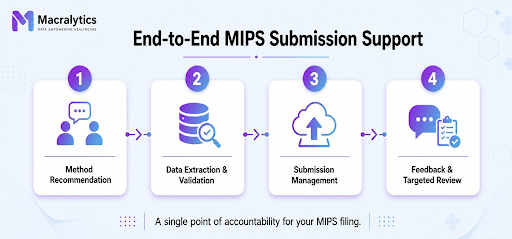
Macralytics supports MIPS data submission through a four-step service workflow that adapts to the practice’s preferred reporting method.
- Method recommendation: Based on practice size, specialty, CEHRT maturity, and budget, Macralytics identifies the highest-yielding reporting method. This is typically the Macralytics Qualified Registry for most groups, or a QCDR partner for specialty practices.
- Data extraction and validation: Data is exported from the practice EHR when applicable or entered via the Macralytics portal. The team validates data completeness, case minimums, and audit-prep documentation.
- Submission: Data is transmitted to CMS through the chosen method during the January 2 through March 31 submission window.
- Feedback review: After CMS releases the annual MIPS feedback report, the team reviews attribution accuracy and files Targeted Reviews if discrepancies appear.
Practices that prefer a single point of accountability can let Macralytics handle the filing end-to-end, and we submit it for you.
Will MIPS Value Pathways (MVPs) Replace the Five Traditional MIPS Reporting Methods?
No, MIPS Value Pathways (MVPs) are not replacing the five traditional MIPS reporting methods.
MVPs are a measure-bundling framework, not a replacement for the five reporting methods. Clinicians reporting an MVP still submit data through one of the five traditional methods: Registry, EHR, QCDR, claims, or Web Interface legacy.
Two points define the current direction:
- CMS has signaled that MVPs will become the preferred MIPS reporting organization over time, to phase out open measure-selection Traditional MIPS for most clinicians. The reporting methods themselves remain in place.
- For the 2026 performance year, both Traditional MIPS and MVP paths remain available. MVPs are voluntary for the 2026 performance year, except for specific MVP requirements applied to certain APM Entity participants.
MIPS Reporting Methods at a Glance for 2026
MIPS Reporting Methods are the five CMS-approved channels for submitting performance data under the Merit-Based Incentive Payment System: Qualified Registry, EHR via CEHRT, QCDR, Medicare Part B claims, and the sunsetting CMS Web Interface. Most groups land on Registry as the default. Specialty practices pivot to QCDR. Small practices weigh claims-based against Registry. CEHRT-mature practices add direct EHR submission. MIPS Value Pathways run alongside as a parallel framework that uses the same five reporting methods underneath. For broader context, see the Merit-Based Incentive Payment System (MIPS) guide.
Schedule your free MIPS consultation.
Drop your work email and a certified MIPS consultant will reach out to schedule a personalized consultation, no obligation.