
MIPS Special Statuses: Designations, Effects & Exceptions


MIPS Special Statuses are CMS-defined designations and exception paths within the Merit-Based Incentive Payment System (MIPS) that reduce reporting burden, reweight performance categories, or substitute alternative scoring methodologies for clinicians who meet specific criteria. CMS recognizes five designations: Small Practice, Rural Practice, Non-Patient-Facing, Hospital-Based, and APM.
It also includes two exception paths: the CMS Hardship Exception and Extreme and Uncontrollable Circumstances (EUC). For the 2026 performance year, all special-status determinations apply once CMS confirms eligibility through the MIPS Determination Period.
What are MIPS Special Statuses?
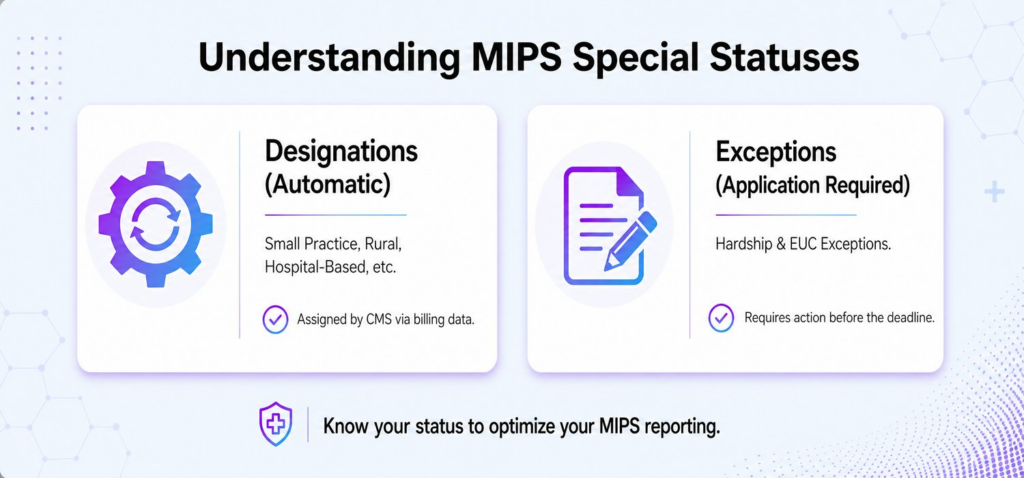
MIPS special statuses are CMS-recognized designations and exception paths that change a clinician’s MIPS reporting requirements, scoring methodology, or eligibility for full participation, applied automatically by CMS during the MIPS Determination Period or, in the case of exceptions, requested by the clinician through a formal application.
The five status categories are: Small Practice, Rural Practice, Non-Patient-Facing, Hospital-Based, and APM. CMS determines these automatically based on practice characteristics measured during the Determination Period. Two status categories are exceptions – Hardship and EUC. These require either a filed application or a CMS-declared circumstance, and they excuse reporting in specific categories rather than reclassifying the practice.
The practical distinction matters for planning: designations are something CMS assigns to you based on billing data you already generate, while exceptions are something you have to act on before a deadline. Missing that distinction is the most common reason practices leave a favorable status unclaimed or miss a filing window.
Does CMS Notify Clinicians of Their MIPS Special Status?
Yes, CMS notifies clinicians of their assigned MIPS special status via the Quality Payment Program (QPP) portal at qpp.cms.gov, which is accessed with HARP credentials. The notification appears in the MIPS feedback section once CMS completes the Determination Period analysis.
Clinicians do not receive separate email or paper notifications, and the QPP portal is the authoritative source. In practice, status assignments can also be checked before the performance year starts using CMS’s MIPS Participation Status Tool, which reflects preliminary Determination Period data before the final feedback release.
Can a Clinician Hold Multiple MIPS Special Statuses Simultaneously?
Yes, a clinician or group can hold multiple MIPS designations at the same time. Common combinations include Small Practice plus Rural Practice, a small practice in a rural area. Hospital-Based plus Non-Patient-Facing describes an inpatient-only specialist.
Small Practice plus Non-Patient-Facing describes a small specialty practice with limited patient-facing encounters. When multiple statuses apply, CMS applies the most favorable combination of effects. Reweighting is additive up to the point where a single category hits zero; it does not go negative or compound past that floor.
How Does CMS Determine MIPS Special Status?
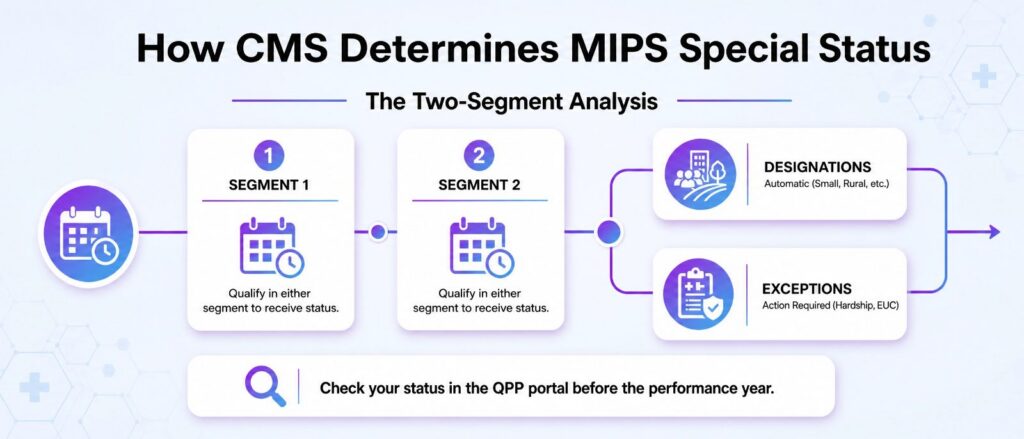
CMS determines MIPS special status through the MIPS Determination Period, a two-segment analysis of clinician characteristics during the prior year, completed before the performance year begins.
The Determination Period uses two non-overlapping 12-month segments– a primary segment and a secondary segment, each roughly a year long and offset from each other. CMS classifies a practice as small, rural, hospital-based, or non-patient-facing based on whichever segment supports the designation; a practice only needs to qualify in one of the two windows, not both, to receive the status.
Designations, all five categories, apply automatically based on that analysis – no application, no attestation. Exceptions, Hardship, and EUC require clinician action: a filed Hardship Exception application by December 31, or a CMS-declared EUC determination that still requires an application for individual (non-blanket) cases. Determinations are communicated through the QPP portal, covered above.
What are the 5 MIPS Designations?
CMS recognizes five MIPS designations that change reporting requirements based on practice characteristics, each applied automatically during the MIPS Determination Period.
| Designation | Qualifying Threshold | Primary Scoring Effect |
|---|---|---|
| Small Practice | TIN with 15 or fewer eligible clinicians | +10 IA bonus; automatic PI reweighting if PI not submitted |
| Rural Practice | Practice location in a CMS-designated rural area or HPSA | Reweighting and bonus consideration alongside other statuses |
| Non-Patient-Facing | 100 or fewer patient-facing encounters in the Determination Period | PI automatically reweighted to zero |
| Hospital-Based | 75% or more of covered services in inpatient, HOPD, or ER settings | Eligible for Facility-Based Scoring |
| APM Participant | Participation in a CMS-recognized APM Entity | Eligible for the APM Performance Pathway (APP) |
How do MIPS Special Statuses Affect Scoring and Reporting?
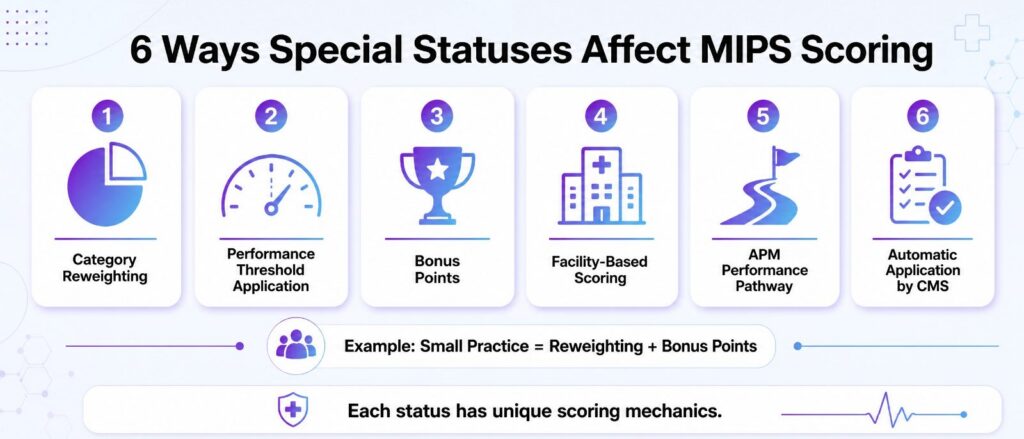
MIPS special statuses produce six categories of effects on MIPS reporting and scoring: Category Reweighting, Performance Threshold Application, Bonus Points, Facility-Based Scoring, the APM Performance Pathway, and Automatic Application by CMS.
No single special status produces all six. Small Practice triggers Category Reweighting, Bonus Points, and Automatic Application. Hospital – Based triggers Category Reweighting plus Facility-Based Scoring eligibility plus Automatic Application.
The six sections below cover each effect and, where the mechanics genuinely change the math, show the numbers.
1. Category Reweighting
Category Reweighting is the most common effect of a MIPS special status. One or more performance categories are reweighted to zero, and the remaining categories absorb the freed-up weight proportionally under CMS’s re-normalization rule.
Promoting Interoperability (PI)is the category reweighted most often – to zero for Small Practice (when no PI data is submitted), Hospital -Based, Non – Patient- Facing, and ASC-Based clinicians. Here is what that actually does to the score, using the standard default weighting of Quality 30%, Cost 30%, IA 15%, PI 25%:
- If PI is reweighted to zero and Cost is still calculable: Quality moves to 40%, Cost stays functionally unchanged relative to Quality’s gain, and IA moves to 30%.
- If PI is reweighted to zero and Cost cannot be calculated(common for specialties without enough attributed cost measures), Quality and IA each move to 50%.
That second scenario is worth flagging to clients directly: a specialist who loses both PI and Cost is now scored almost entirely on Quality and IA.
A weak Quality measure set at that point does far more damage than it would under standard weighting. Quality and IA are reweighted only under a Hardship Exception or EUC determination, not under any of the five automatic designations.
2. Performance Threshold Application
Performance Threshold Application is the second cross-cutting effect. CMS finalized the Performance Threshold at 75 points for the 2026 performance year and confirmed it will hold at 75 points through the 2028 performance year– the first multi-year stability commitment since MIPS launched. The threshold applies identically to every clinician regardless of special status.
Performance year 2026 determines the 2028 payment adjustment under MIPS’s standard two-year lag – the score a practice posts this year is not felt in Medicare Part B remittances until 2028. What special status changes is not the threshold itself but how easily a practice reaches it.
With a category reweighted to zero, the surviving categories carry more of the Final Score. That is a real advantage for a practice that performs well in Quality and IA, and a real liability for one that does not.
The upside has shrunk regardless of special status. CMS retired the exceptional performance bonus pool after the 2022 performance year, and the program’s budget-neutrality math – a scaling factor capped at 3.0 applied to a pool funded entirely by penalties collected from clinicians who score below 75 – has compressed positive adjustments in every cycle since.
The most recently finalized cycle (PY2024 performance, paid out in 2026) capped the maximum positive adjustment at +1.05%, against a statutory ceiling of ±9%. That figure belongs to the prior cycle, not this one – CMS will not finalize the 2028 payment adjustments for the current PY2026 cycle until the national performance distribution is in. But the trend it reflects is the reason a badly-reweighted category still matters far more on the downside, which runs the full -9%, than the upside currently rewards on the way up.
3. Bonus Points (Small Practice IA Bonus)
Bonus Points is the third cross-cutting effect, and it applies specifically to Small Practice. CMS awards a flat +10 Improvement Activities (IA) category bonus to clinicians under small-practice status, added on top of the practice’s attested IA score.
The bonus lands differently than it used to. CMS retired the high/medium activity-weighting tiers starting with the 2025 performance year – every attested Improvement Activity now carries an equal, flat point value rather than the old 10/20 – point split by weight class. That simplifies the math for small practices choosing which activities to attest: activity selection no longer needs to chase “high – weighted” activities specifically, since all activities now contribute the same amount before the +10 bonus is layered on top.
Rural Practice does not carry an automatic IA bonus of its own, though rural clinicians frequently qualify for Small Practice simultaneously and pick up the bonus through that designation instead. Non-Patient-Facing, Hospital-Based, and APM designations carry no category-level bonus at all.
4. Facility-Based Scoring (Hospital-Based Clinicians)
Facility-Based Scoring is the fourth effect and is available to Hospital-Based clinicians. The hospital’s Hospital Value-Based Purchasing (HVBP)score substitutes for the clinician’s MIPS Quality and Cost category scores whenever that substitution produces a higher MIPS Final Score than Traditional MIPS reporting would.
CMS runs both calculations automatically and applies whichever score is higher – the clinician does not elect this, and no separate submission is required to activate it. Two conditions have to hold: the clinician needs Hospital-Based status (75% or more of covered services in HOPD, inpatient, or ER settings), and a facility-based score has to exist for their affiliated hospital in the first place. A hospital-based clinician affiliated with a facility that has no HVBP score on file simply reports Traditional MIPS with no substitution available.
5. APM Performance Pathway
The APM Performance Pathway (APP)is the fifth effect, available to clinicians under APM status. It swaps out the standard Quality measure-selection process for the APM Entity’s pre-aligned measure set, which is the main source of the reduced reporting burden associated with APM participation.
PI and IA continue to be reported on the standard MIPS basis under APP; there is no APM-specific modification to those two categories. Cost is still calculated normally from Medicare Part B claims. The practical effect is that APP mainly compresses the Quality-reporting workload, not the whole MIPS submission.
6. Automatic Application by CMS
Automatic Application by CMS is the sixth effect, and it is a statement about who must act. The five designations apply automatically once CMS’s Determination Period analysis confirms eligibility. The two exceptions require it – a filed Hardship Exception by December 31, or an EUC application for individual (non-blanket) circumstances.
Because designations are automatic, misclassification happens more often than practices expect – a small practice misclassified as non – small, or a rural location CMS’s system fails to recognize. These are correctable, but only through Targeted Review, filed after CMS releases performance feedback, not before. Practices that check their QPP portal status only once, at year-end, are the ones most likely to catch a misclassification too late to fix it for that payment year.
What MIPS exceptions are available?
CMS recognizes two MIPS exception paths that excuse a clinician from reporting one or more performance categories when specific circumstances apply, independent of whether any of the five designations also apply.
- CMS Hardship Exception: A filed application that reweights the affected category or categories to zero for CMS-approved circumstances: decertified CEHRT, insufficient internet connectivity, a Public Health Emergency, or Extreme and Uncontrollable Circumstances filed individually rather than under an automatic blanket policy. The PY2026 filing deadline is December 31, 2026.
- Extreme and Uncontrollable Circumstances (EUC): It applies automatically to clinicians in a CMS-declared PHE or disaster area, with no application needed for blanket-designated areas or via individual application for clinicians outside a blanket declaration who were still affected.
Whether these two can be combined for the same category is a separate question, covered below.
How do MIPS Special Statuses tie into Eligibility?
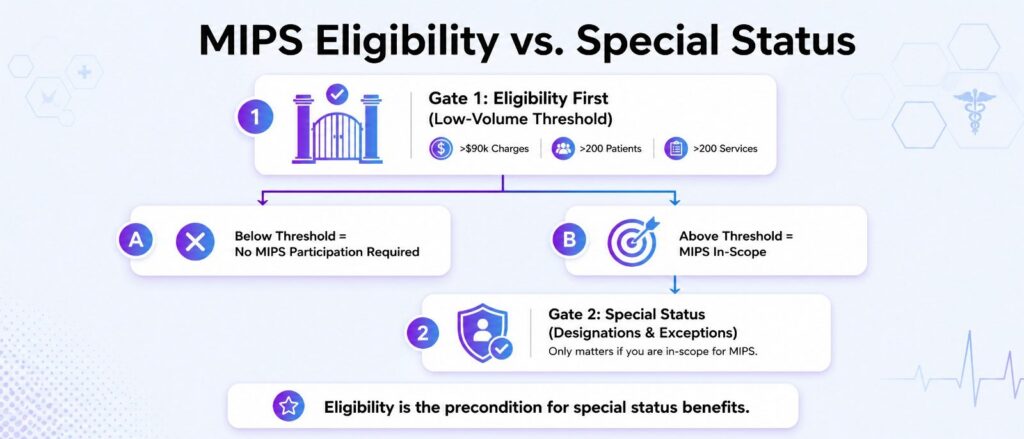
MIPS special statuses are tied to MIPS eligibility, and the confusion between the two is common enough to warrant a clean separation. The same Determination Period that classifies special status also evaluates a clinician against the low – volume threshold: more than $90,000 in Medicare Part B allowed charges, more than 200 patients, and more than 200 covered professional services, all three, in both segments of the Determination Period.
A clinician who does not exceed all three elements of that threshold in both segments is not required to participate in MIPS at all – special status is irrelevant to them, because they are out of scope for reporting in the first place.
A clinician who exceeds the threshold and also carries a small-practice designation participates fully, but with the bonus and reweighting attached. Eligibility comes first; special status only matters once a clinician is already in scope.
How Does Macralytics Check Your MIPS Special Status?
Macralytics verifies a practice’s MIPS special status through a four -step consultation workflow that confirms automatic designations, identifies missed status opportunities, and stages exception applications ahead of deadlines.
- Determination Period review: Pull the practice’s historical Medicare Part B claims, NPI/TIN – level eligibility data, and current QPP portal feedback to confirm which automatic designations CMS has assigned, or should have assigned, for the current performance year.
- Missed-status identification: Flag designations the practice qualifies for but CMS has not applied: a misclassified small practice, an unrecognized rural location, or an underused Hospital-Based or APM pathway.
- Exception staging: For clinicians facing PI reporting gaps, decertified CEHRT, or PHE-affected operations, prepare Hardship Exception or EUC documentation ahead of the December 31 deadline rather than after it.
- QPP portal verification: Monitor status throughout the performance year and file Targeted Reviews after feedback release if a designation was misapplied.
Can a clinician stack the CMS Hardship Exception with an EUC determination?
No, a clinician cannot stack the CMS Hardship Exception with an EUC determination for the same MIPS performance category in the same reporting cycle. CMS applies whichever exception produces the more favorable outcome when both could apply, but reweighting a category to zero is the ceiling either exception can produce. There is nothing to stack past that floor.
That non-stacking rule applies per category, not per clinician. A clinician can hold a Hardship Exception for Promoting Interoperability while an EUC determination separately affects Quality in the same cycle – those are two different categories, so both apply independently. What cannot happen is filing both a Hardship Exception and an EUC claim for the same category, expecting a compounded effect; CMS treats this as a single zero-weight outcome and disregards the redundant filing.
The practical takeaway: File whichever exception actually matches the circumstance- hardship for a CEHRT decertification, EUC for a declared PHE- rather than filing both defensively. Redundant filings create audit overhead with no upside in scoring.
Schedule your free MIPS consultation.
Drop your work email and a certified MIPS consultant will reach out to schedule a personalized consultation, no obligation.