
MIPS Small Practice: Criteria, Bonus & Reweighting


MIPS Small Practice is a CMS-defined Merit-Based Incentive Payment System (MIPS) special status assigned automatically to Taxpayer Identification Numbers (TINs) with 15 or fewer eligible clinicians. The designation triggers four scoring accommodations: Promoting Interoperability (PI) reweighting to zero, a +10 Improvement Activities (IA) category bonus, data-completeness threshold flexibility, and a 3-point minimum on Quality measures below the 20-case minimum.
This article covers the criteria CMS uses to determine small-practice status, the +10 IA bonus mechanic, and the reweighting effects that apply throughout the 2026 performance year (PY2026).
What Is a MIPS Small Practice?
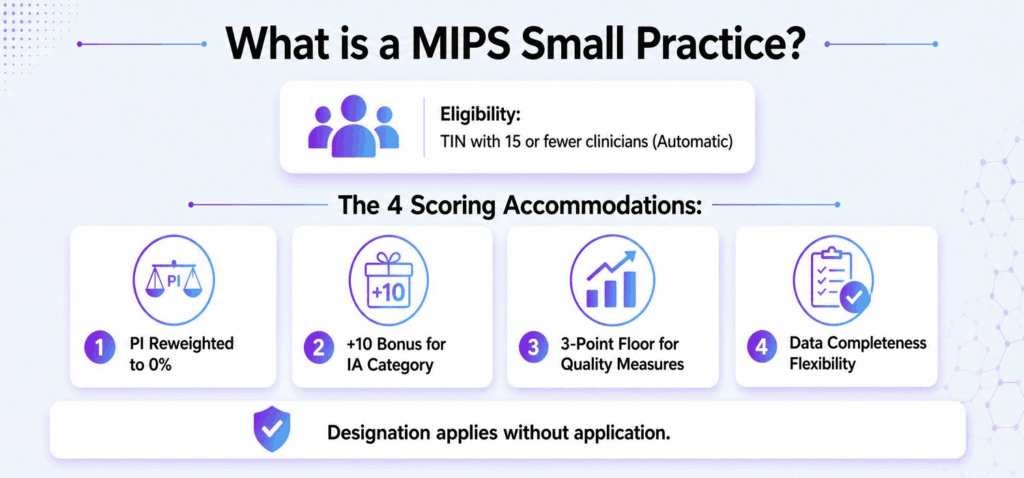
A MIPS small practice is a CMS-defined MIPS special status that is automatically applied to Taxpayer Identification Numbers (TINs) with 15 or fewer eligible clinicians, providing scoring accommodations across the four MIPS performance categories.
Small-practice status affects how MIPS scoring is calculated for the TIN. The PI category is reweighted to zero. The IA category receives a +10 bonus. The Quality category applies a 3-point floor for measures below the 20-case minimum. CMS also gives small practices flexibility on the standard 75 percent data-completeness rule for certain measures.
Together, these are the four scoring accommodations that define the designation in practice. Each accommodation operates at a different point in the MIPS Final Score calculation. Each accommodation applies without any practice election.
CMS assigns small-practice status during the MIPS Determination Period. Practices do not apply to the designation. CMS evaluates eligible-clinician counts at the TIN level and confirms status through the Quality Payment Program (QPP) portal.
The designation carries through the full 2026-2028 MIPS cycle. PY2026 performance is scored under small-practice accommodations, reported back in MIPS feedback during 2027, and paid out as the calendar year 2028 Medicare Part B payment adjustment.
Three questions define the boundaries of the designation. Does CMS notify clinicians of the status? Can a multispecialty TIN qualify? How does CMS define an eligible clinician for the 15-clinician count? The three H3 sections below answer each question directly.
Does CMS Notify Clinicians of Small-Practice Status?
Yes– CMS notifies clinicians of small-practice status through the Quality Payment Program (QPP) portal at qpp.cms.gov, accessed with HARP credentials. The notification appears in the MIPS feedback section once CMS completes the Determination Period analysis, typically before the performance year begins. Clinicians do not receive separate email or paper notifications.
The QPP portal is the authoritative source. Practices confirm the status by logging in with HARP credentials, opening the eligibility view for the TIN, and checking the special-status indicators listed against each National Provider Identifier (NPI).
Can a Multispecialty TIN Qualify as a MIPS Small Practice?
Yes – a multispecialty TIN with 15 or fewer eligible clinicians qualifies for MIPS small-practice status the same way a single-specialty TIN does. CMS counts eligible clinicians at the TIN level, not by specialty. A multispecialty group of 12 clinicians qualifies as a small practice. A group of 4 primary care physicians, 4 cardiologists, and 4 endocrinologists under one TIN meets the threshold.
CMS applies no specialty-mix restrictions to the 15-clinician threshold. Specialty composition affects Quality measure selection and Cost measure attribution, but specialty composition never affects the small-practice determination itself.
How Does CMS Define ‘Eligible Clinician’ for the 15-Clinician Threshold?
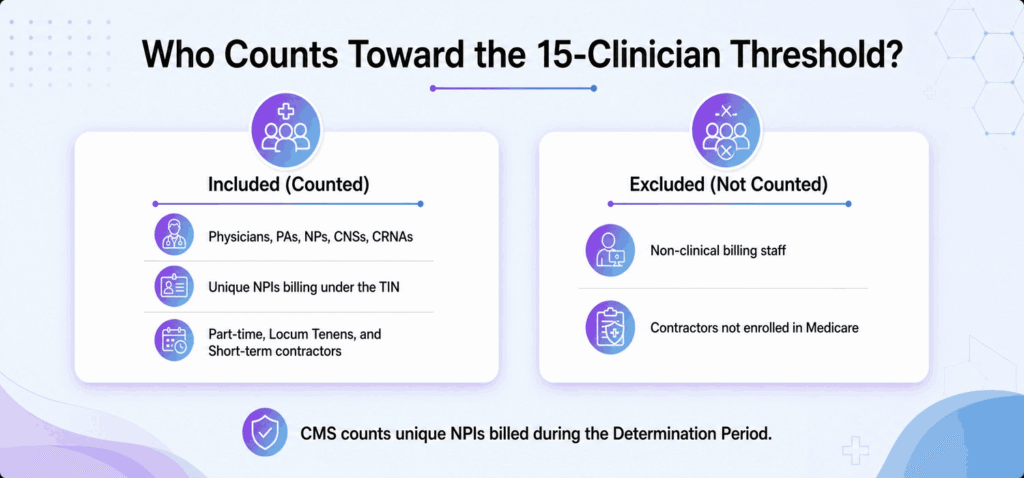
CMS defines an eligible clinician for the small-practice 15-clinician threshold as a Medicare-enrolled clinician whose clinician type falls within the MIPS-eligible clinician list. The list covers physicians, physician assistants (PAs), nurse practitioners (NPs), clinical nurse specialists (CNSs), certified registered nurse anesthetists (CRNAs), and additional clinician types added by CMS in recent rule cycles.
CMS counts each unique eligible clinician by National Provider Identifier (NPI) billing under the TIN during the Determination Period. Non-clinical billing staff is not counted. Contractors not enrolled in Medicare are not counted. Clinicians outside the MIPS clinician-type list are not counted.
Two edge cases matter for practices near the threshold. Clinicians who joined the practice during the Determination Period count if the clinicians billed Medicare under the TIN. Locum tenens and short-term contracted clinicians count if the clinicians are billed under the practice TIN. A practice at 14 permanent clinicians that ran 2 locum NPIs through the TIN during the Determination Period counts 16 and misses the threshold.
How Does MIPS Small Practice Fit Into MIPS Special Statuses?
MIPS small practice is one of seven MIPS Special Statuses recognised by CMS – five designations(Small Practice, Rural Practice, Non-Patient-Facing, Hospital-Based, APM) plus two exception paths(Hardship and EUC).
MIPS small practice sits in the designations group. The designation applies automatically based on practice characteristics, specifically the TIN-level eligible-clinician count. The other four designations also apply automatically. The two exception paths require clinician action or a CMS declaration.
Multi-status overlap is common. A small practice that also qualifies for Rural Practice or Non-Patient-Facing status receives all applicable designations simultaneously. CMS applies the combined effects without double-counting any single accommodation. The rural and non-patient-facing overlaps are covered in the two sibling-status sections later on this page.
What Criteria Define a MIPS Small Practice?
The MIPS small-practice designation rests on three CMS-defined criteria– a TIN-level eligible-clinician threshold, a Determination Period evaluation window, and an automatic-application mechanic that applies the designation without requiring practice action.
The three criteria together determine whether and when small-practice status applies for a performance year. The threshold criterion answers the “who qualifies” question. The Determination Period criterion answers the “when is qualification measured” question. The automatic-application criterion answers the “what must the practice do” question, and the answer is nothing.
Each criterion carries operational detail that decides borderline cases. A practice at 15 or 16 clinicians’ lives or dies on how the count works. A practice that grew mid-year lives or dies on the evaluation segment CMS uses. A practice unaware of the designation still receives every accommodation because no election exists to miss.
The three noun-phrase sections below develop each criterion at specialist depth: the TIN-Level 15-Eligible-Clinician Threshold, the Determination Period Evaluation, and Automatic Application by CMS.
TIN-Level 15-Eligible-Clinician Threshold
The primary MIPS small-practice criterion is the TIN-level 15-eligible-clinician threshold. A Taxpayer Identification Number (TIN) qualifies as a small practice when 15 or fewer eligible clinicians bill Medicare under that TIN during the MIPS Determination Period.
The threshold applies at the TIN level, not the individual NPI level. A clinician working under multiple TINs is counted separately under each TIN. Solo clinicians billing under their own NPI/TIN combination are small practices by default.
The count itself is strict, not an average. CMS counts all eligible clinicians who billed Medicare under the TIN during the Determination Period. A TIN with 15 clinicians qualifies. A TIN with 16 does not. No rounding, proration, or full-time-equivalent conversion applies.
One edge case matters for reporting-unit selection. Small-practice status applies to the TIN. Within a small-practice TIN, individual clinicians can still report at the NPI level for individual MIPS scoring. The small-practice accommodations apply to whichever reporting unit the clinician uses, TIN or NPI.
A solo cardiologist inside a 12-clinician TIN who reports individually still receives the +10 IA bonus, the PI reweighting, and the 3-point Quality floor, because the TIN holds the designation and the designation follows the clinician’s reporting unit.
Determination Period Evaluation
CMS evaluates small-practice status during the MIPS Determination Period – a two-segment analysis of TIN-level eligible-clinician counts conducted during the year preceding the performance year.
The Determination Period uses two non-overlapping 12-month segments, a primary segment and a secondary segment. CMS assigns small-practice status if the TIN meets the 15-or-fewer threshold during either segment. The practice does not need to qualify in both.
The two-segment design protects practices from edge-case fluctuations. A TIN that grew to 16 clinicians during the secondary segment but had 14 during the primary segment still qualifies as a small practice for the performance year.
Hiring decisions are made mid-Determination-Period; therefore, they rarely strip a practice of the designation in the same cycle. The reverse pattern also holds. A TIN at 16 clinicians in the primary segment that dropped to 15 in the secondary segment qualifies on the secondary segment alone. Either qualifying window is sufficient.
CMS communicates the Determination Period result through the QPP portal MIPS feedback section once the analysis is complete. Practices near the 15-clinician line should check the portal at the start of each performance year rather than assume the prior year’s status carried over.
Automatic Application by CMS
MIPS small-practice status applies automatically once CMS completes the Determination Period evaluation. No application, opt-in election, or practice action is required to receive the designation.
The contrast with the exception paths is the defining feature. CMS Hardship Exceptions require a filed application. Extreme and Uncontrollable Circumstances (EUC) determinations require a CMS declaration or an individual application.
The small-practice designation triggers automatically based on the TIN-clinician count. Practices take no action to receive the designation, and practices cannot decline the designation.
Verification Remains the Practice’s Responsibility
Practices should confirm the designation appears in the QPP portal once CMS publishes Determination Period results. Missing or incorrect designations can be challenged through Targeted Review after the MIPS feedback release.
A small practice whose feedback report shows no +10 IA bonus and full PI scoring has a misclassification worth filing on. Automatic application also stacks with every other special status. Small-practice status applies alongside any other special status the TIN qualifies for.
A small practice in a CMS-designated rural area receives both designations and the combined effects of each. Neither designation displaces nor dilutes the other.
What Is the MIPS Small-Practice IA Bonus?
The MIPS small-practice IA bonus adds +10 points to the Improvement Activities (IA) category score for clinicians and groups under the small-practice special status – the most direct scoring benefit of the designation.
CMS applies the +10 bonus automatically once small-practice status is confirmed. The bonus stacks with the practice’s reported IA activities up to the IA category’s 100-point maximum. No attestation names the bonus, no submission carries the bonus, and no reporting method changes the bonus.
The bonus is simple at the headline level and specific at the mechanical level. The mechanics decide how much of the +10 actually lands.
A practice that reported 95 IA points receives only 5 effective bonus points because the category caps at 100. A practice that reported 50 receives the full 10.
Four sections below develop the bonus at that mechanical level: the +10 IA Category Bonus itself, the Automatic Bonus Application Mechanic, the IA Category Ceiling Effect with a worked example, and a Boolean on whether the bonus stacks with other MIPS bonuses.
+10 IA Category Bonus
The +10 IA category bonus is the headline MIPS small-practice scoring benefit. CMS adds 10 points to the practice’s Improvement Activities (IA) category score once small-practice status is confirmed.
The IA category context frames the size of the benefit. The IA category has a default weight of 15 percent in the MIPS Final Score formula and a 100-point internal scoring scale. The +10 bonus represents a 10-percentage-point lift on the IA category before category weighting.
Final Score impact is smaller than the raw +10 suggests, but still material. A small-practice +10 IA bonus typically translates to approximately 1.5 points on the MIPS Final Score on the 0-100 scale, depending on category-weight re-normalization.
PI is reweighted to zero for small practices, which shifts IA’s effective weight upward from 15 percent to 20 percent, covered in the reweighting section below. At the reweighted 20 percent IA weight, the +10 category bonus is worth up to 2 Final Score points when uncapped.
The bonus faces no separate cap at the category level beyond the ceiling itself. A practice that reported 90 IA category points reaches exactly 100 with the +10 bonus. A practice that reported more than 90 losses the excess above 100, a dynamic developed in the IA Category Ceiling Effect section below.
Automatic Bonus Application Mechanic
CMS applies the +10 IA bonus automatically once small-practice status is confirmed. No practice claim, attestation, or supplemental submission is required.
The trigger is the status itself. The bonus triggers automatically when CMS confirms small-practice status during the Determination Period evaluation. CMS adds the bonus to the IA category score during MIPS Final Score calculation. Practices do nothing to claim the bonus, and practices cannot forfeit the bonus by omission.
Verification follows the standard feedback cycle. Practices verify the bonus was applied by checking the MIPS feedback report after CMS releases the report, typically in the summer of 2027 for PY2026, ahead of the calendar year 2028 payment adjustment.
A missing bonus indicates a misclassified small-practice status. Misclassifications can be challenged through Targeted Review during the review window that follows the feedback release.
The bonus is also reporting-method independent. The bonus applies regardless of which of the five MIPS reporting methods the practice uses: Qualified Registry, EHR, QCDR, claims, or Web Interface. The bonus applies regardless of which IA activities the practice submitted.
A small practice attesting to a single IA activity receives the same +10 as a small practice attesting to four activities, subject only to the 100-point category ceiling.
IA Category Ceiling Effect
The +10 IA bonus is subject to the IA category’s 100-point ceiling. The practice’s combined reported IA points plus the +10 bonus cannot exceed 100 within the IA category.
The ceiling mechanic is easiest to see in a worked example. A practice that reported 95 IA category points and qualifies for the +10 small-practice bonus does not reach 105 points.
The IA category caps at 100. The effective bonus in this case is only +5 points, the gap between 95 and 100. A practice with 50 reported IA points receives the full +10 bonus and reaches 60.
The following table shows the ceiling effect across three reporting levels:
| Reported IA Points | +10 Bonus Applied | Final IA Score | Effective Bonus |
|---|---|---|---|
| 50 | +10 | 60 | +10 (full) |
| 90 | +10 | 100 | +10 (full, exact fit) |
| 95 | +10 | 100 (capped) | +5 (partial) |
The table shows that 90 reported points is the efficiency frontier: the last level at which the full bonus lands.
The strategic implication is a 90-point IA target. Small practices targeting maximum MIPS scoring should select IA activities that bring the reported IA score to approximately 90, leaving 10 points of headroom that the small-practice bonus fills exactly. Over-reporting IA does not reward the practice beyond the 100-point ceiling. Attestation effort spent above 90 is wasted effort.
Does the Small-Practice IA Bonus Stack With Other MIPS Bonuses?
Yes – the +10 IA category bonus stacks alongside other MIPS bonuses that apply at the Quality category level: the complex-patient bonus, the end-to-end electronic reporting bonus, and the high-priority Quality measure bonus. The bonuses operate in different categories, IA versus Quality, so the bonuses do not compete for the same cap. Quality-category bonuses are subject to their own 10-point cap.
The small-practice IA bonus has only the 100-point IA-category ceiling. A small practice can therefore receive +10 IA from the small -practice bonus AND up to +10 Quality bonus points from the Quality -category bonuses simultaneously. The two bonus streams reinforce each other in the Final Score without offsetting anywhere in the calculation.
How Is MIPS Small-Practice Scoring Reweighted?
MIPS small-practice scoring is reweighted in three ways beyond the +10 IA bonus – Promoting Interoperability (PI) is reweighted to zero, data-completeness thresholds are applied flexibly for certain Quality measures, and Quality measures below the 20-case minimum receive a 3-point floor instead of the standard 0-1 low-volume scoring.
The three reweighting effects operate at three different layers of the MIPS calculation. PI reweighting operates at the category-weight layer, removing an entire category from the Final Score formula. The data-completeness adjustment operates at the measure-submission layer, softening the penalty for borderline completeness. The 3-point floor operates at the measure-scoring layer, setting a minimum score for low-volume measures.
The layered design matters because the effects compound. A small practice with a limited patient panel benefits from all three simultaneously: no PI burden, partial credit on borderline-completeness measures, and 3 points per below-case-minimum measure.
Competitor pages typically bury these effects inside general scoring content. This page develops each effect as a discoverable section of specialist depth.
Four sections follow: PI Reweighting to Zero, the Data-Completeness Threshold Adjustment, the Quality Measure 3-Point Floor Below Case Minimum, and a Boolean on voluntary PI reporting under the reweighted status.
Promoting Interoperability (PI) Reweighting to Zero
Promoting Interoperability (PI) is automatically reweighted to zero for MIPS small practices. The practice is not required to report PI measures, and PI’s default 25 percent weight in the MIPS Final Score formula redistributes proportionally to the remaining categories.
The rationale is burden relief. PI requires the 2015 Edition Cures Update Certified EHR Technology (CEHRT) and detailed measure attestation. CMS recognises the CEHRT and attestation requirements as a disproportionate burden for small practices. Automatic reweighting removes the burden while preserving small practices’ ability to compete on Quality, Cost, and IA.
The re-normalization math determines the new category weights. When PI is reweighted to zero, the remaining 75 percent of the weighting re-normalizes to 100 percent proportionally:
| Category | Default Weight | Small-Practice Reweighted |
|---|---|---|
| Quality | 30% | 40% |
| Cost | 30% | 40% |
| Promoting Interoperability | 25% | 0% |
| Improvement Activities | 15% | 20% |
Each surviving category’s share is its default weight divided by the remaining 75 percent: Quality moves from 30 percent to 40 percent, Cost from 30 percent to 40 percent, and IA from 15 percent to 20 percent, summing to 100 percent. Full re-normalization mechanics live on the scoring and payment hub.
The practical consequence is concentration. Quality and Cost together carry 80 percent of a small practice’s Final Score. Small practices that report PI voluntarily can earn points back into the Final Score, covered in the voluntary PI Boolean below.
Data-Completeness Threshold Adjustment
The data-completeness threshold adjustment for MIPS small practices applies the standard 75 percent data-completeness rule with operational flexibility. CMS treats small-practice Quality measure submissions favourably when measure-level completeness falls just below 75 percent, recognising the smaller patient panels small practices serve.
The standard rule sets the baseline. CMS requires Quality measure data on at least 75 percent of eligible encounters during the performance year for full benchmark scoring. The 75 percent rule applies to all clinicians regardless of special status. Small practices are not exempt from the rule itself.
The adjustment changes what happens below the line. Small practices that fall just below 75 percent completeness still receive partial credit rather than the default 0 score that non-small practices would face.
CMS applies sliding-scale scoring for small practices in the 50-75 percent completeness band, where larger practices would score 0 or 1 point on the same submission.
The adjustment is a safety net, not a target. Small practices pursuing Quality category points should still aim for 75 percent or higher data completeness on every submitted measure.
The sliding-scale band protects measures where a small patient panel made full completeness genuinely difficult. A 4-clinician practice submitting a measure at 68 percent completeness keeps partial credit that a 40-clinician group at the same completeness level loses entirely.
Quality Measure 3-Point Floor Below Case Minimum
A MIPS Quality measure submitted by a small practice with fewer than 20 cases during the performance year receives a 3-point minimum measure score – the small-practice 3-point floor – instead of the default 0-1 point low-volume benchmark CMS applies to non-small practices.
The standard rule sets the context. CMS requires at least 20 cases per Quality measure for full decile benchmark scoring. Measures below the 20-case minimum normally fall back to a low-volume benchmark that caps the measure score at 1 point in many cases.
The small-practice variant substitutes a floor for the cap. For small practices, CMS applies a 3-point measure-score floor in place of the 0-1 low-volume treatment. The floor applies automatically. No practice action is required, and no separate attestation invokes the floor.
The practical effect protects Quality performance when patient – mix limits case counts. Small practices reporting Quality measures with smaller patient panels still earn 3 points per below-case-minimum measure. A dermatology solo practice whose sixth measure reached only 14 cases banks 3 points on that measure instead of 1.
Across a six-measure Quality submission with two low-volume measures, the floor is worth up to 4 additional Quality points versus the non-small-practice treatment. The floor turns the 20-case minimum from a scoring cliff into a manageable slope for small patient panels.
Can a MIPS Small Practice Voluntarily Report PI?
Yes , a MIPS small practice can voluntarily report Promoting Interoperability even though the category is reweighted to zero. Voluntary PI reporting earns the practice additional MIPS Final Score points, because PI is scored normally if voluntarily submitted, without removing the small-practice reweighting safety net.
If the voluntary PI score would reduce the Final Score, CMS keeps the reweighted-to-zero treatment. The practice faces upside with no downside on the submission decision.
Voluntary reporting is appropriate when the small practice already has the 2015 Edition Cures Update CEHRT in place and can submit PI measures without significant additional burden. A practice with strong e-prescribing and health information exchange numbers converts existing workflow data into Final Score points.
How Does the MIPS Improvement Activities (IA) Category Credit Small Practices?
The MIPS Improvement Activities (IA) Category is the destination of the +10 small-practice bonus covered above. This section explains how the IA Category credits small practices at the category level.
The IA Category measures clinician-attested practice-improvement activities: care coordination, patient engagement, population health, and expanded access. The category carries a default weight of 15 percent in the MIPS Final Score and a 100-point internal scoring scale. Under small – practice PI reweighting, the effective IA weight rises to 20 percent, which raises the Final Score value of every IA point a small practice earns.
The small-practice credit exists to close a resource gap. CMS designed the +10 IA bonus to lift IA category performance for clinicians who may have fewer resources to attest to high-weight IA activities. Larger groups can distribute attestation work across administrative staff.
A 6-clinician practice cannot. The bonus closes part of the gap between small practices and larger groups on the IA category without requiring additional attestation effort.
Category-level strategy still matters beyond the bonus. Activity selection, attestation documentation, and the 90 – day continuous performance requirement all sit at the category level.
What Is MIPS Rural Practice?
MIPS Rural Practice is the CMS-defined MIPS special status assigned to clinicians practicing in CMS-designated rural areas or Health Professional Shortage Areas (HPSAs) – a sibling designation that often applies alongside MIPS small practice.
Dual-status overlap is the operative point for readers of this page. A small practice located in a rural area receives BOTH designations simultaneously. CMS applies the combined effects without double -counting any single reweighting.
A rural small practice does not receive two PI reweightings or two IA bonuses. The practice receives the union of applicable accommodations once.
The two designations rest on independent criteria. MIPS small practice depends on TIN-level clinician count: 15 or fewer eligible clinicians. MIPS Rural Practice depends on practice location: a CMS -designated rural ZIP code or HPSA.
Neither criterion references the other. A 40-clinician rural health system holds rural status without small-practice status. A 10-clinician suburban group holds small-practice status without rural status.
Rural status carries its own eligibility mechanics, scoring modifiers, and PI exemptions that sit outside this page’s scope.
What Is MIPS Non-Patient-Facing?
MIPS Non-Patient-Facing is the CMS-defined MIPS special status assigned to clinicians with 100 or fewer patient-facing encounters during the Determination Period.
Dual-status overlap follows the same pattern as the rural sibling. A small practice whose clinicians have 100 or fewer patient-facing encounters receives BOTH designations. Both statuses reweight PI to zero. CMS applies the reweighting once, with no double-counting, so the combined effect on the category weights is identical to holding either status alone.
The two statuses differ in the unit of measurement. MIPS small practice is TIN-level: the 15-or-fewer eligible-clinician count attaches to the Taxpayer Identification Number.
MIPS Non-Patient-Facing is measured at the individual-clinician level: the 100-or-fewer patient-facing encounter count attaches to each NPI, with a separate group-level test when more than 75 percent of a TIN’s NPIs qualify. Pathologists, radiologists, and anesthesiologists commonly hold non-patient-facing status inside TINs of every size.
A 9-clinician pathology group typically holds both designations at once: small practice by TIN count, non-patient-facing by encounter count.
How Does Macralytics Support MIPS Small Practices?
Macralytics offers a dedicated MIPS Small-Practice Package – a four-step service workflow tailored to the +10 IA bonus, PI reweighting, data-completeness, and 3-point Quality floor accommodations covered above.
The four steps run in sequence across the performance year:
- Small-practice verification – the team confirms small-practice status via the QPP portal and flags any misclassifications that need Targeted Review filing.
- IA-maximization planning – the team selects IA activities that bring reported IA points to approximately 90, leaving 10 points of headroom that the +10 bonus fills exactly, capped at 100.
- Quality measure selection – the team chooses Quality measures that work within the practice’s patient panel, favouring measures that the practice can reach 20 or more cases on.
- Voluntary PI evaluation – the team evaluates whether voluntary PI reporting would lift the Final Score for the practice CEHRT configuration.
Each step maps to one of the scoring accommodations documented on this page. Verification protects the designation itself. IA planning captures the full bonus. Measure selection minimises reliance on the 3-point floor. The PI evaluation converts the no-downside voluntary option into a scored decision.
Should a Small Practice Opt In to MIPS Reporting If Exempt Under the Low-Volume Threshold?
It depends – whether a small practice should opt in to MIPS reporting depends on the practice’s confidence in scoring above the 75-point Performance Threshold. Opt-in elections lock the practice into the full MIPS scoring cycle for the performance year.
The opt-in mechanic defines who faces the question. Small practices that exceed only one or two of the three low-volume threshold criteria – $90,000 in Medicare Part B billings, 200 patients, 200 covered services – but not all three are eligible to opt in to MIPS. Practices exceeding all three are MIPS-eligible with no election required. Practices exceeding none are excluded entirely.
The favourable case is a confident scorer. A small practice confident of scoring above the 75-point Performance Threshold should consider opting in. The small-practice accommodations make threshold-clearing significantly easier: PI reweighted to zero, +10 IA points, the 3-point Quality floor, and data-completeness flexibility. Clearing the threshold in PY2026 earns a positive Medicare Part B payment adjustment in calendar year 2028 under the standard two-year lag.
The unfavourable case is a Quality unknown. A small practice uncertain about Quality category performance may face a negative-adjustment outcome in 2028, plus a full year of reporting burden. Opting in is a binding commitment for the performance year. The practice cannot opt out mid-cycle once the election is submitted, regardless of how mid-year Quality data trends. Practices should model a projected Final Score against the 75-point line before electing.
MIPS small practice is a CMS-defined Merit-Based Incentive Payment System (MIPS) special status that applies automatically to TINs with 15 or fewer eligible clinicians. The designation triggers four scoring accommodations: a +10 Improvement Activities (IA) category bonus, Promoting Interoperability (PI) reweighting to zero, a data-completeness threshold adjustment, and a 3-point Quality measure floor below the 20-case minimum.
The criteria are TIN-level and automatic, the bonus is capped only by the 100-point IA ceiling, and the reweighting concentrates 80 percent of the Final Score into Quality and Cost. All four accommodations run through the full 2026-2028 cycle, from PY2026 reporting to the 2028 payment adjustment.
Schedule your free MIPS consultation.
Drop your work email and a certified MIPS consultant will reach out to schedule a personalized consultation, no obligation.